










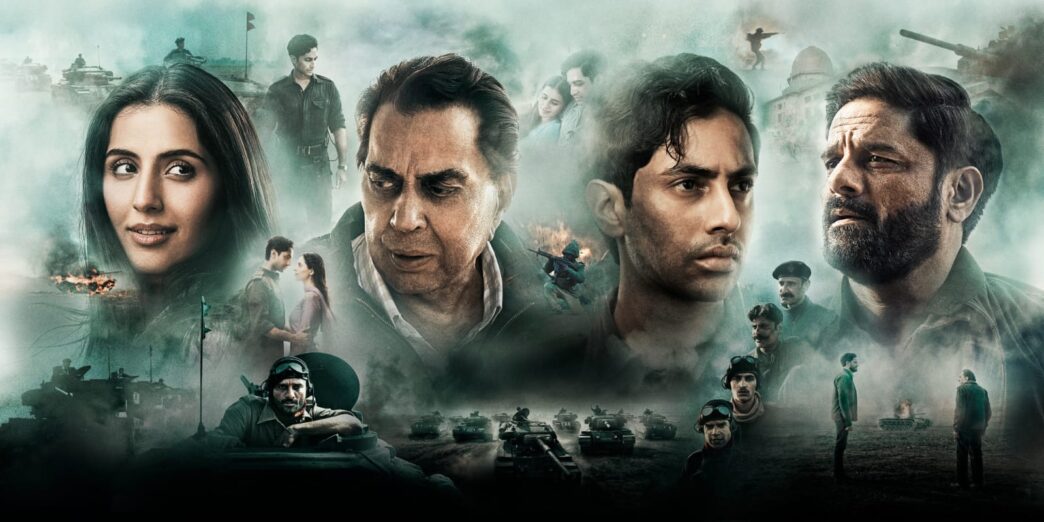
Some films chase applause. Some provoke slogans. And then there are films that leave audiences silent. Ikkis belongs firmly to the last category. It is not a film you walk out of discussing loudly, it’s one you absorb quietly, with a heaviness that stays long after the credits roll.
Inspired by the life of Captain Arun Khetarpal, who received the Param Vir Chakra at just 21, Ikkis deliberately avoids the familiar template of chest-thumping patriotism. Instead, it chooses a more difficult and honest path, focusing not on victory, but on loss and the absence a fallen soldier leaves behind.
The film moves between two timelines. One is set during the 1971 India–Pakistan war, where a young tank commander Arun Khetarpal (Agastya Nanda) faces the enemy with unwavering resolve. The other unfolds years later, after the Kargil conflict, when his father, Brigadier M.L. Khetarpal (Dharmendra), travels to Pakistan under the guise of a college reunion. Hosted by Pakistani Brigadier Nasir (Jaideep Ahlawat), the visit slowly becomes an emotional confrontation with the past.
What makes Ikkis stand apart is that its most powerful moments arrive not during battle, but in its aftermath. The film finds its emotional weight in quiet conversations, long pauses, and unspoken understanding between men who once stood on opposite sides of the border.
Director Sriram Raghavan, known for razor-sharp thrillers, takes a restrained and reflective approach here. His storytelling relies more on mood than momentum. Certain images like a fleeting shot through a tank’s periscope carry the weight of history. While the early portions feel uneven, especially during the training and flashback sequences, the film grows more confident and emotionally resonant as it progresses.
The heart of Ikkis lies in its performances. Dharmendra delivers one of the most moving roles of his career. His portrayal of a grieving father is built on silence moist eyes, faltering breath, and a pain that never needs to be verbalised. It is a performance marked by dignity and restraint.
Jaideep Ahlawat brings remarkable depth to his role as a Pakistani officer who understands the meaning of honour beyond national lines. His scenes with Dharmendra form the emotional backbone of the film and elevate it beyond a conventional war narrative.
Agastya Nanda fits the role physically and conveys discipline and sincerity, but his emotional range feels limited. While he convincingly portrays courage, the deeper psychological conflict of a young man walking toward sacrifice remains underexplored. Simar Bhatia, in her debut, leaves a gentle impression, adding quiet support to the narrative without demanding attention.
The background score by Tanuj Tiku and Ketan Sodha complements the film’s tone without overpowering it. The war sequences are grounded and realistic, avoiding unnecessary spectacle or melodrama.
In a time when war films often lean toward aggressive nationalism, Ikkis takes a more thoughtful stance. It recognises that respect and humanity can exist even between enemies. This perspective may feel uncomfortable to some viewers, but it is also what gives the film its emotional honesty.
Ikkis is most powerful when it stops trying to prove anything. It doesn’t aim to inflate pride it chooses to leave a void. And that lingering emptiness is the film’s greatest strength.
This is not a story of victory. It is a remembrance.
Of a son who never returned.
Of a father who lived with that loss.
And of a nation that often remembers its heroes in silence.
Rating: ★★★★☆ (4/5)








[…] Ikkis Review: A War Film That Speaks Loudest in Silence […]