







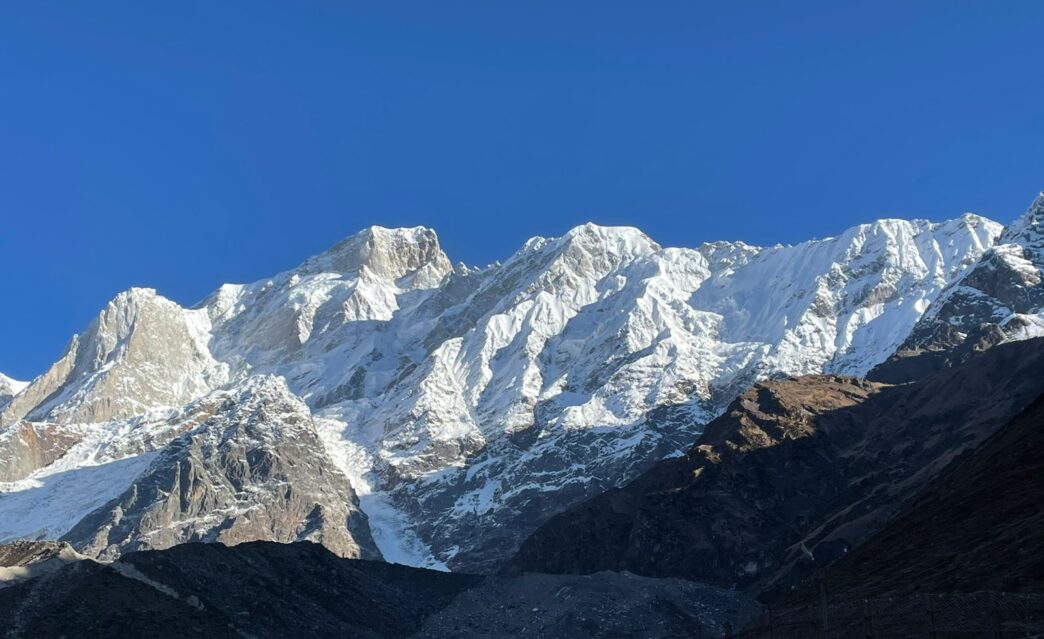
There’s something about the mountains that language never fully captures, yet somehow, the heart understands. The moment you arrive not just physically, but emotionally , there’s a shift. A silence. A kind of soft undoing that starts beneath the surface, where no one sees, but everything begins to change. I’ve felt it across altitudes and time zones: in the early chill of Gangtok mornings, in the stillness of Kalpa’s untouched air, in the reckless winds of Triund, and in the quiet, prayer-soaked alleys of Pokhara. Every time, the story repeats. I come heavy with thoughts, with ache, with some version of myself that the city sculpted without consent. But as I begin to look, to really see the ridges, the wild sky, the ordinary beauty of a stranger offering chai something within me loosens its grip. It feels like a grief I didn’t name finally leaves the room. Not dramatically, but with quiet permission. And I wonder how the mountains do that. Not once, not occasionally but every time.
Maybe it’s the sheer scale. Maybe it’s how they’ve existed long before my pain, my joy, my arrival and will stand long after. There’s a humility in that, the kind that pulls your ego out of its endless echo. In the city, we perform. In the mountains, we return. The self here is simpler, stripped down, breathing in real time. I don’t travel to escape. I travel to observe, to listen, to catch life in its rawest, most honest form. I’ve always believed travel isn’t about ticking places off maps it’s about noticing what’s quietly alive around you. A cloud curling around a peak. A child’s laughter echoing through a valley. A signboard faded by snow and time. When I walk through these mountain towns, I watch the light change and let it teach me. I let the silence confront me. I let the altitude demand my presence.
Lately, the world seems to be arriving here too. The rise in mountain tourism isn’t just wanderlust it’s modern restlessness seeking ritual. People are choosing solitude over stimulation, pine forests over pixels, and homestays over hotel check-ins. There’s a visible migration of the soul back to slowness. Cafés in Tirthan brim with remote workers. Artists are sketching on trails in Spiti. In Kasar Devi, silence has become a form of currency. It’s no longer about adventure; it’s about alignment. The mountains have become therapy without appointment, clarity without explanation. And maybe that’s what we’re all searching for. Not a destination, but a feeling. A way of being that feels less like running and more like returning.
Each journey to the hills leaves me quieter than before, but somehow more full. I’ve stopped trying to photograph the perfect view. I’ve stopped chasing signal. Instead, I sit. I breathe. I remember how it feels to be small, and how oddly comforting that is. These places have taught me that beauty isn’t loud, it’s patient. That peace isn’t the absence of noise, it’s the ability to carry quiet within. On World Tourism Day, I carry only one truth: the mountains don’t need us. But we, perhaps more than ever, need them. To slow us. To soften us. To remind us of what we once knew that everything we’re searching for might just be found where the roads end and the silence begins.
READ MORE: Diljit Dosanjh Bags International Emmy 2025 Nomination for ‘Amar Singh Chamkila’